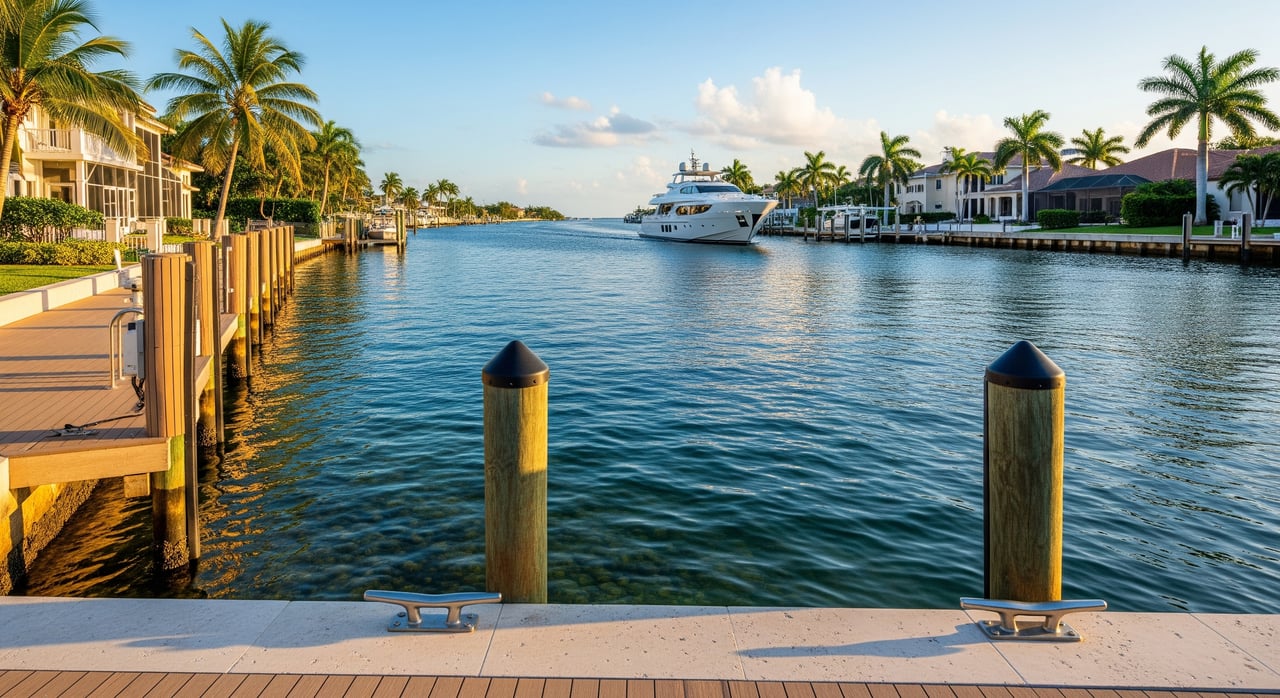
Bringing your boat to Royal Harbor? The canal outside your future home can make or break your boating life. If you want smooth access, safe docking, and stress-free turning, you need to understand canal widths, turning basins, depth, draft, and tides before you buy. This guide walks you through what matters, how to verify it, and the practical margins that help you match the right lot to your vessel. Let’s dive in.
What really decides canal fit
Every canal and lot in Royal Harbor is different. As-built widths, dredged depths, and turning space can vary by finger, bend, or even by property. Public charts give context for Naples Bay, but private canals can differ.
Focus on these elements when you evaluate a property:
- Canal width at your frontage and at the narrowest point of the finger.
- Alignment and bends that affect your approach and ability to pivot.
- Presence and size of a turning basin near the canal end.
- Finger piers, docks, and pilings that reduce usable width.
- Any signs of shoaling or submerged obstructions.
Where to get exact numbers
You can and should verify dimensions and depths with authoritative sources. Public charts typically do not map private canal bottoms or recent shoaling, so go to the records that apply to the exact canal.
- Start with the Royal Harbor HOA or property manager. Ask for as-built canal plans, recorded plats, and the most recent bathymetric or dredging records.
- Check Collier County records and GIS plats for canal widths, right-of-way lines, and any easements.
- Look up U.S. Army Corps of Engineers and Florida Department of Environmental Protection permits for authorized dredge depths and work limits.
- Use NOAA charts and tide predictions for Naples Bay to understand approach routes and open-water controlling depths.
- Hire a professional marine surveyor or licensed local captain to run a low-water sounding and test maneuvers on site.
How canal width affects maneuvering
Width is about more than just passing through. You need room to handle wind, current, and low-speed corrections near docks and other boats.
- A practical rule of thumb is at least 1.0 to 1.5 times your vessel’s beam as lateral clearance on each side when maneuvering slowly. Tighter clearances raise the risk of contact.
- Expect single-direction traffic in many residential canals. Comfortable two-way passing often requires a channel width roughly 2 to 3 times the length overall (LOA) for similar-size recreational boats.
Example: A 30-foot cruiser with a 9-foot beam typically docks more easily with about 6 to 7 feet of side clearance per side. If piers or pilings encroach, your usable waterway narrows fast.
Turning basins and LOA
Turning room usually limits boat size more than canal length. Captains often plan for a 360-degree turn within a circle that is 1.5 to 3 times the LOA in calm conditions. For most buyers, a conservative planning number is 2 times LOA, especially for conventional single-screw setups.
- If you run a 35-foot boat, target a turning basin near 70 feet across for comfort under typical conditions.
- Tight dog-legs and encroachments can increase the turning diameter you need, even if the basin looks wide on paper.
- Always test a turn at low wind and at the lower end of the tide to see the true limits.
Depth, draft, and tides
Depth and draft planning is about consistent access, not just high-tide days. Know your vessel’s draft at rest, and add a safety buffer for under-keel clearance.
- Vessel draft is the vertical distance from the waterline to the deepest point of your hull or drive.
- Controlling depth is the lowest navigable depth along your route, often measured at the lowest tide level used for charts.
- In Southwest Florida, older or shallower residential canals are often in the approximate 3 to 6 foot range at normal levels, and deeper dredged communities may run roughly 6 to 10 feet. These are general ranges, not property-specific values.
- The Gulf side of Collier County typically sees about 1 to 2 feet of astronomical tidal range. Wind setup, barometric pressure, and storm surge can move levels higher or lower for short periods.
Plan your clearance at the lowest expected water level. For many powerboats in the 25 to 40 foot range, a practical target is 1 to 2 feet of under-keel clearance at the lowest water, with larger margins for heavier displacement or inboard setups.
Propulsion and clearance
Your drive type matters. Sterndrives and outdrives sit low and can be vulnerable when depths are marginal. Inboards and saildrives benefit from added clearance. If your numbers are tight, a small change in tide or silt shifts can put your gear at risk.
- Favor conservative clearance margins in canals with siltation history.
- Confirm actual controlling depths with a current survey, not assumptions or old records.
Seasonal and maintenance factors
Private canals can shoal between dredging cycles. Permitting timelines can affect when and how dredging occurs.
- Ask for the date of the last dredge, the authorized dredge depth, and the typical maintenance cycle.
- Check for any restrictions tied to seagrass, mangroves, or shoreline work that could limit future dredging or dock changes.
- Verify seawall condition. Failures can affect depths and access over time.
Buyer checklist for Royal Harbor tours
Bring your boat data, ask the right questions, and verify in writing. Use this quick checklist.
- Measure your vessel: LOA, beam, draft including props or drives, and air draft if needed.
- Request from the HOA: as-built canal plans, recorded plat, the latest bathymetric survey with date, and dredging records.
- Read the HOA covenants for dock size, pile placement, boat lift rules, and any limits on LOA or beam.
- Ask about encroachments. Confirm whether nearby docks or platforms reduce usable width.
- Walk the site at a predicted low tide. Look for shoaling near canal mouths, bends, or lift areas.
- Hire a licensed local captain to test the route and, if possible, a professional marine surveyor to log depths at low water.
Plan your route to the Gulf
Even if your slip is perfect, you still need reliable access through Naples Bay and related channels. Public charts can help you understand open-water depths and hazards, but they will not provide exact bottom elevations inside private canals.
- Identify the controlling depths on your route, especially at low water.
- Check for any fixed bridge or clearance considerations along your path.
- If your draft is near a route’s controlling depth, schedule a proving run at a lower tide with a local captain before you commit.
When to bring in the pros
For boats over about 30 to 35 feet or for deeper drafts, a professional pre-offer check is smart. A marine surveyor can chart depths in front of the lot, verify lift areas, and flag shoaling. A licensed captain can test turns and approaches in real conditions and spot practical risks.
Pair those findings with HOA records, county plats, and any dredging permits. The goal is a clear, documented picture of widths, depths, and turning room based on today’s conditions.
Ready to find the right lot?
Matching a boat to a Royal Harbor property is about confidence. Confirm the canal width at your frontage and at pinch points, verify turning basin size, document controlling depths at low water, and understand the dredging history. Use conservative margins for draft and turning so your home and your boating lifestyle fit from day one.
If you want a guided, concierge approach to canal verification, documentation gathering, and property selection, reach out to the Mauceli Grech Group. Our team pairs local expertise with hands-on, practical guidance so you can move forward with clarity.
FAQs
What canal widths are typical in Royal Harbor?
- Widths vary by canal finger and lot. Rely on the HOA’s as-built plans, county plats, and a current bathymetric survey to confirm usable width at your exact property.
How much turning room does my boat need?
- Many captains plan for a turning circle between 1.5 and 3 times LOA in calm conditions, with about 2 times LOA as a conservative target for typical single-screw powerboats.
How deep are canals at low tide in Southwest Florida?
- General guidance shows older or shallower canals around 3 to 6 feet and deeper dredged areas around 6 to 10 feet, but you must confirm current depths for the specific canal and lot.
Do tides in Collier County affect access planning?
- Yes. The area often sees about 1 to 2 feet of astronomical tidal range, and wind or pressure can push levels higher or lower temporarily. Plan your under-keel clearance for the lowest expected level.
What HOA documents should I request before touring?
- Ask for as-built canal plans, recorded plats, the latest bathymetric survey with date, dredging records, and the covenants covering docks, lifts, and vessel size.
Who maintains dredging for private canals?
- Many residential canals are private and maintained by the HOA or developer. Confirm the last dredge date, authorized depth, and the schedule for future maintenance.